Home / Articles
5 Places to Never Inject Filler (and Why)
Home / Articles
5 Places to Never Inject Filler (and Why)
Below, let’s talk about five areas that responsible surgeons and seasoned injectors often treat with extreme caution — or avoid altogether. And more importantly, why.
If you’ve ever heard of “filler blindness,” chances are this is the area that comes up first. The glabella — that small groove between your eyebrows — is home to some of the face’s trickiest blood vessels, including the supratrochlear and supraorbital arteries. Injecting filler here can accidentally block an artery that supplies blood to the retina. The result? Sudden, irreversible blindness that no treatment can reverse.
It’s a sobering risk that every patient deserves to know about. Some people come in asking for fillers here to soften deep frown lines when Botox alone isn’t enough. What people often overlook is that deep glabellar lines are usually best treated with a combination approach: repeated neuromodulators (Botox or Xeomin) to weaken the muscle over time, skin resurfacing to improve texture, and sometimes gentle micro-needling or skin boosters to help stimulate collagen naturally.
In rare cases where a tiny amount of filler is used, it must be done with the utmost care — usually with a blunt cannula instead of a sharp needle, using micro-droplets, and by a doctor who understands facial vascular anatomy like the back of their hand. If you ever hear a provider say “It’s just a quick jab here,” walk away.
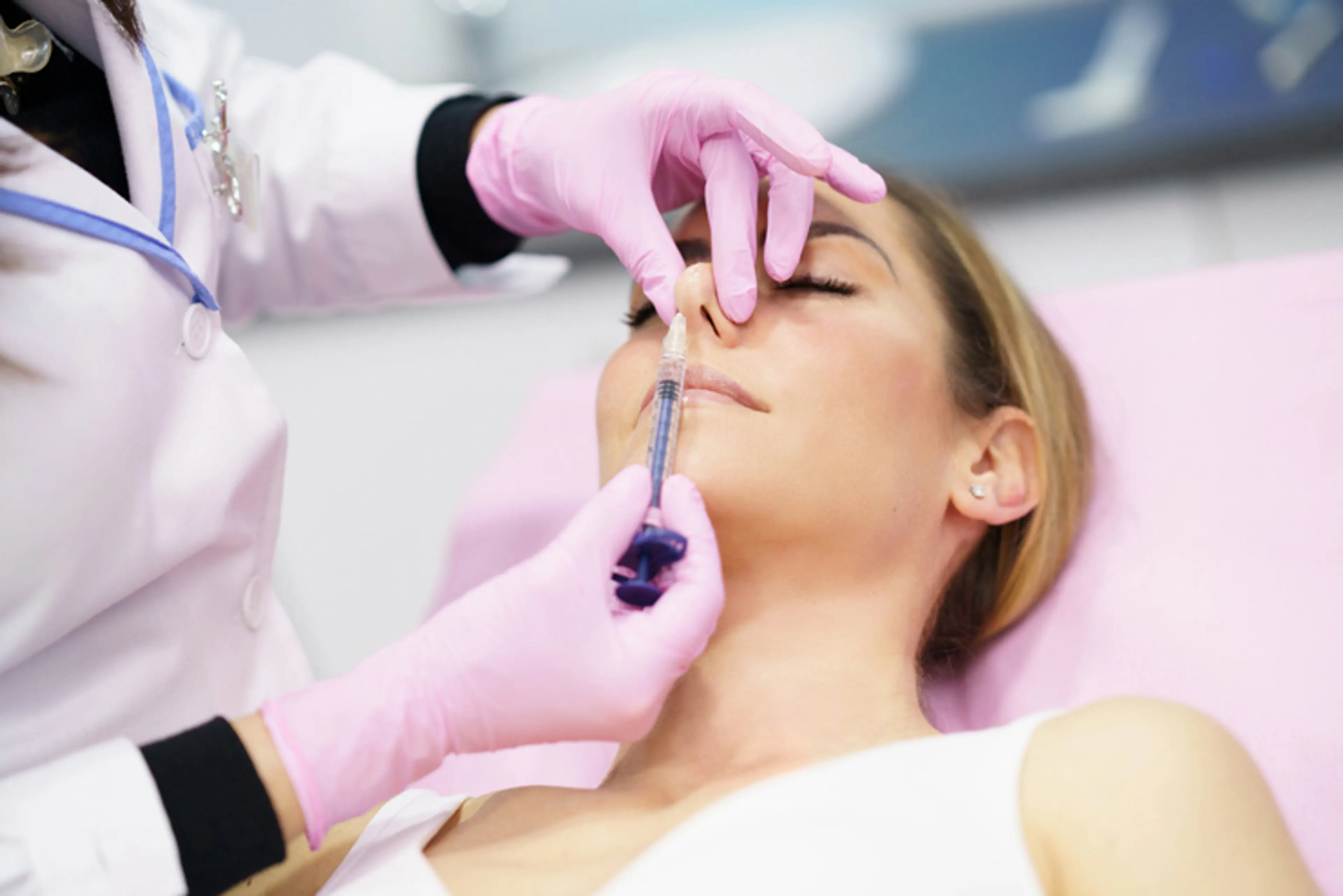
Nonsurgical nose fillers have exploded across Korea, China, and the wider Asian beauty scene in the past decade — often branded as a “liquid rhinoplasty.” For many people, it’s an attractive option: a sharper nose bridge, a subtle tip lift, no surgery, minimal downtime. Who wouldn’t be tempted?
But here’s what you might not see in glossy Instagram before-and-afters: the nose is a vascular minefield. The dorsal nasal artery, angular artery, and branches connected to the ophthalmic artery all converge here. If filler enters one of these vessels and travels backward, it can block blood flow to the retina in seconds. The damage is immediate — vision loss, skin necrosis, or even tissue death on the nose itself.
To be honest, the nose is not a playground for casual injectors. At Hugo Plastic Surgery, we perform nonsurgical nose refinement only in carefully selected cases — and only when the patient understands both the benefits and the real risks. For lasting, predictable results, many patients are better off considering surgical rhinoplasty under controlled conditions. Modern surgical techniques are highly refined, with incisions hidden inside the nostrils or under the nose, and downtime often shorter than many expect.
If you’ve been thinking about lifting or refining your nose, do your research. Ask for before-and-after examples, safety protocols, and whether your goals might be better served by a permanent surgical solution instead of repeated risky injections.
In an era when “baby face” fullness is trending across Asia — a soft, youthful forehead is high on many wish lists. A flat or sunken forehead can create shadows that make the face appear harsher or older. So naturally, many patients think, “Just inject some filler to round it out!”
But the forehead is one of the most technically demanding areas for injectable treatments. Why? Beneath that smooth skin lies a complex network of arteries, veins, and the frontal branch of the superficial temporal artery. Inject too superficially and you can see visible lumps or an unnatural contour. Inject too deeply and there’s a risk of hitting a vessel that supplies blood to the scalp or eyes.
A common alternative in Korea — and one we often recommend at Hugo — is micro-fat grafting. Using your own purified fat, we can gently layer volume into the forehead with fewer risks of vascular complications. Fat tends to integrate more naturally and feels softer than hyaluronic acid fillers in this area.
Of course, fat grafting isn’t always perfect either — some fat may resorb over time, and touch-ups can be needed. But for patients seeking that signature smooth, feminine forehead so popular here, it remains a safer, more natural-looking option when done by a qualified surgeon.
Temples often get overlooked when we think about facial aging, yet they play a major role in how balanced or tired our face appears. As we age, the fat pads in the temples shrink, creating a hollow or concave look. This loss of volume can make the brow look heavy and the upper face appear more angular than we’d like.
So why not just fill it up? Unfortunately, the temples hide a few traps. The superficial temporal artery and vein run through this region — and they vary greatly from one person to another. Inject too close to the artery, and you risk a vascular event. Too shallow, and you get visible lumps or ripples that ruin the natural contour.
Another challenge is migration: temple fillers can shift over time, pooling in unexpected spots because this area is wide, flat, and doesn’t hold product in place as tightly as other zones.
At Hugo Plastic Surgery, we often favor micro-fat grafting for temples instead. With your own fat, we can layer volume precisely and blend it seamlessly with surrounding tissues. The result is a soft, subtle correction that supports the brow and restores youthful fullness without creating odd lumps or migration issues. Patients appreciate that it feels natural to the touch — and the results can last much longer than synthetic filler.
If you stand in front of the mirror and pull the corners of your mouth slightly up, you’ll see why marionette lines bother so many of us. These lines, which run vertically from the corners of the mouth toward the chin, can add a sad or tired expression to an otherwise lively face.
Marionette lines are a classic example of a concern that rarely responds well to “one shot” filler fixes. Often, the true culprit is sagging skin and weakened support deeper in the face. That’s why at Hugo Plastic Surgery, we take a holistic approach: sometimes subtle filler is used to support the corners of the mouth, but more often we combine that with treatments like thread lifting, skin tightening with high-intensity focused ultrasound (HIFU), or even a minor lower facelift for patients who want lasting results.
Think of it like renovating an old house — you can’t just patch the crack; you have to strengthen the beams underneath.
If you’ve read this far, you might be wondering — should I avoid fillers altogether? Not at all. When handled thoughtfully, fillers remain one of the most versatile, transformative tools for modern facial rejuvenation. They restore volume lost with age, contour the cheeks or jawline, enhance the lips naturally, and smooth out lines that simply don’t respond to other treatments.
The secret is knowing that not every dip or wrinkle is asking to be filled. Sometimes the best decision is to combine subtle filler with other procedures — skin resurfacing, collagen stimulators, or surgical lifts — instead of overloading an area that doesn’t benefit from more volume.
At Hugo Plastic Surgery, our philosophy is simple: enhance, don’t inflate. The goal is a refreshed face that still moves naturally, looks beautiful in motion, and ages gracefully over time.
Too many clinics promise “quick and easy” fixes for complex concerns. But your face is not an assembly line. Real artistry and safety come from a deep understanding of facial anatomy, aesthetic balance, and honest communication with every patient.
So if you’re thinking about injectables — especially in areas like the glabella, nose, forehead, temples, or marionette lines — take a moment to ask questions that really matter:
Is my injector medically qualified and experienced with these higher-risk areas?
Do they have emergency protocols for vascular complications?
Are there safer alternatives that could deliver the result I want?
No trendy shortcut is worth risking your health or long-term beauty. And no one should pressure you into more syringes than you need.
At Hugo Plastic Surgery in Gangnam, we see every face as a unique canvas — deserving of the same respect and precision as a masterpiece. We don’t believe in cookie-cutter procedures or upselling the latest “fad” technique. We believe in honest, skillful care that honors your natural features while giving you the refreshed, balanced look you truly want.